Mosquito Anthem
January 26 - February 26, 2021
Exhibition at the XL Gallery
"The mosquito hymn can be seen as a kind of reference to the "Fragment of zoomorphic discourse" series by Andrei Monastyrsky, one of the founders of Moscow conceptualism. Works from this series were presented at the exhibition "Carriers," held at the XL Gallery in 2013: they were entomological illustrations depicting the genitals of mosquitoes and tinted with gold paint. Gold because this is the color traditionally used to paint details, such as the halos of angels, on icons. But it is impossible to see with the naked eye neither angels nor the genitals of mosquitoes. According to Monastyrsky's idea, this conditional invisibility places such different entities in the same contextual field, endows them with the same property: they can exist only in the imagination of the one who thinks about them. And in this respect, something completely insignificant becomes equal to the sacred" – Anatoly Osmolovsky.
Osmolovsky's exhibition is a poignant social project in which unanswered questions and the heat of public sentiment are transformed into a chaotic and uncomfortable space, while retaining visual rigor. The situation with which Osmolovsky works is brought to the point of absurdity: the "sacred" law of the country is unreadable, while the annoying sound of the "mosquito anthem" pours on and on from loudspeakers, meaningless and endless.
Mosquito Hymn
Anatoly Osmolovsky
"The exhibition was initially scheduled for November. However, due to the onset of the coronavirus pandemic and the subsequent lockdown, we rescheduled it for January. As a result, any connections to current events within this exhibition are coincidental. I want to explain the exhibition’s inspiration: one source is the persistent buzz of a mosquito, which has disturbed me since childhood at Pioneer camp. This sound subtly evokes unease, almost like a nightmare. Mosquitoes have consistently affected me negatively; I am often bitten and may even have an allergic reaction. This experience has become a personal preoccupation. In Moscow conceptual art, mosquitoes are also a recurring theme, notably explored by Andrei Monastyrsky, who produced three works centered on mosquitoes.
Monastyrsky’s first work in this series, ‘Mosquitoes-1,’ comprises 30 sheets featuring sketches of mosquito genitalia. Each sheet depicts six mosquito genitals, all adorned with gold and resembling golden halos. The concept emphasizes the uniqueness of each mosquito’s anatomy, so no two are identical. Collectively, these images form a biomorphic abstraction reminiscent of Tengli’s style. The series juxtaposes these drawings with verbatim transcripts from the Congress of People’s Deputies during perestroika, likely from the twenty-seventh Congress. Three sheets and three booklets contain these transcripts, creating a deliberately absurd combination.
Finally, his last work – ‘Mosquitoes-2,’ dating from the 1990s. Monastyrsky learned that there was a representative office of the Republic of Buryatia in the Russian Federation. He took photographs of the signs at the entrance, with their distinctive, unique typeface and design. Golden letters on a dark green background. This work was created for a Western exhibition in Denmark, in a church that serves as an exhibition hall – the main entrance to the church was closed, so everyone had to go through a side chapel. The area was overgrown with bushes. The idea was as follows: to hang two plaques at the museum's main entrance, representing the Republic of Buryatia within the Russian Federation. In Russian and in Buryat. I consider this to be one of his finest works… Monastyrsky works on the very edge of perception. One might say, on the brink of disappearance. Can you imagine: the main entrance is adorned with plaques about the Republic of Buryatia, which, of course, nobody in the West has the faintest idea about. And there’s also a plaque in Buryat – a language that is, one might say, disappearing.
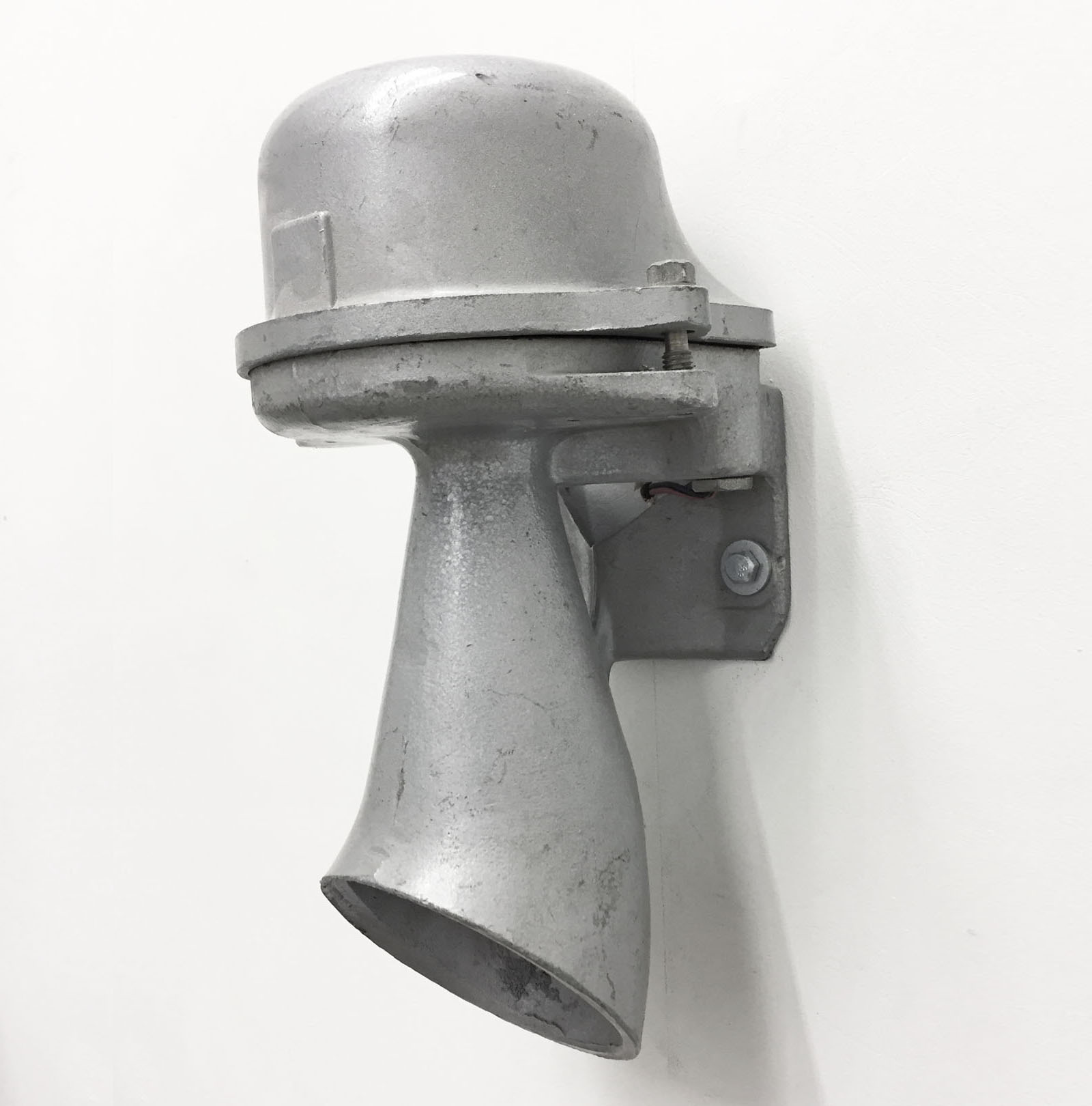
These three works form the foundation of my exhibition, which is structured around four distinct layers or aspects. The first work in the exhibition consists of three panels, each incorporating the buzzing sounds of mosquitoes. The loudspeakers represent this auditory element.
These loudspeakers emit the sound of buzzing mosquitoes. The composition, inspired by Ligeti, emerged through chance processes. Ligeti, whose work appears in Kubrick’s film *2001: A Space Odyssey,* is recognized as the founder of the musical movement ‘sonorism,’ which derives from the word ‘sonor,’ meaning ‘sound.’
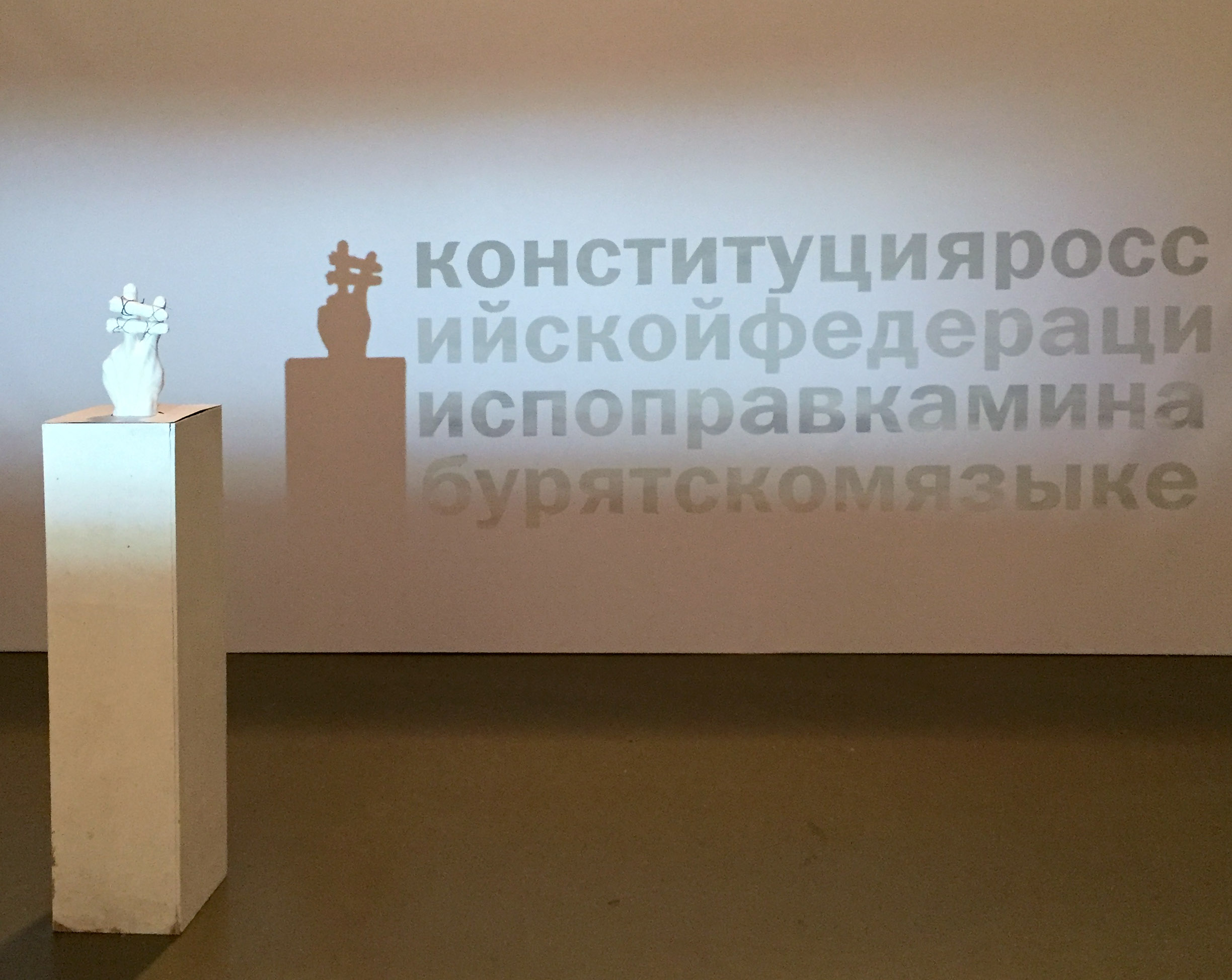
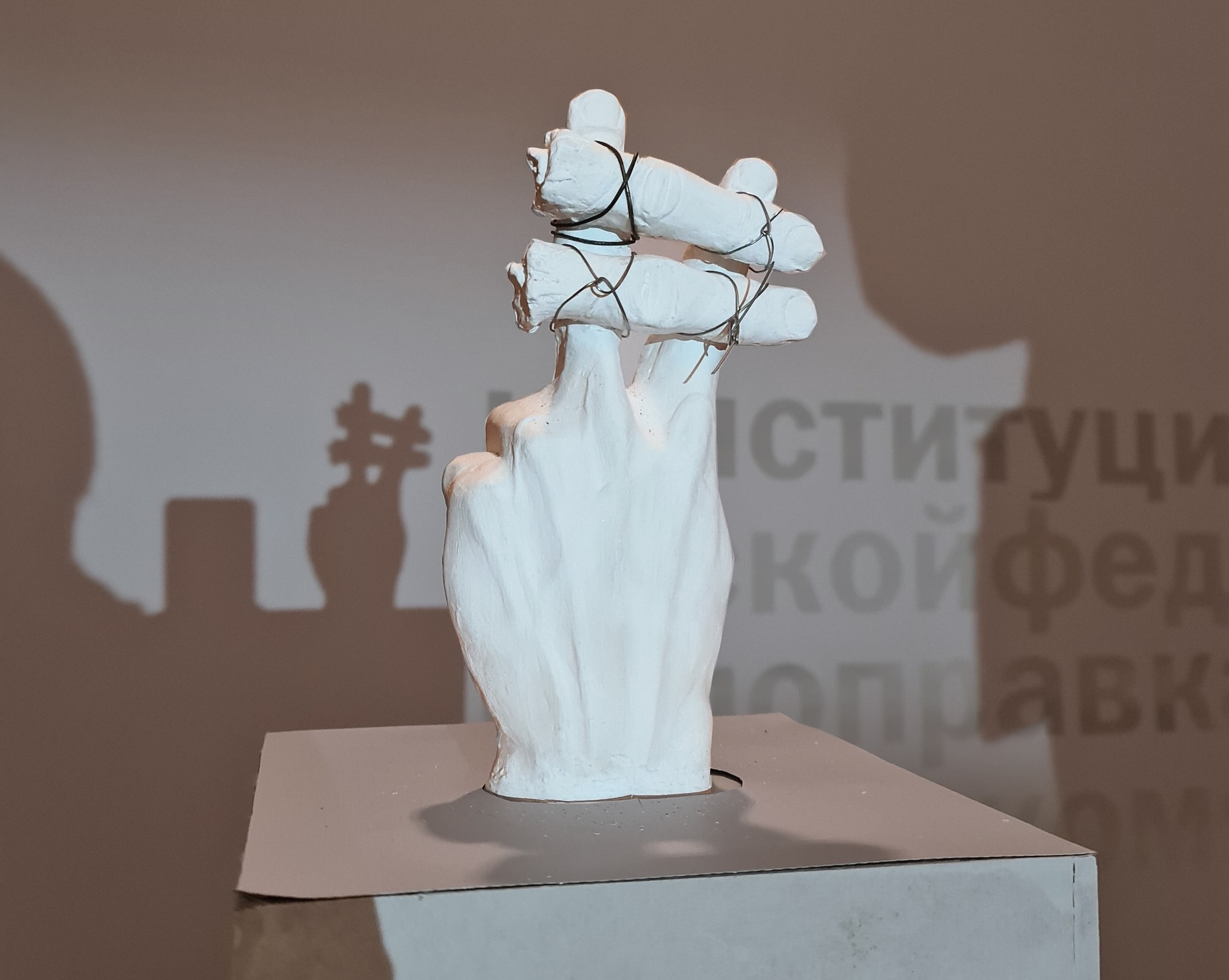
The mosquito sounds influence the adjacent sculpture, which simultaneously serves as a symbol of imprisonment and of victory. The severed fingers evoke tension or menace, suggesting either an unfulfilled victory or confinement. My broader body of work frequently explores hand symbolism. In this piece, the mosquito sounds interact with the sculpture, producing a reflection that manifests as a shadow resembling a hashtag. This prison symbol can also be interpreted as a hashtag. Beneath the sculpture, the inscription reads: ‘The Constitution of the Russian Federation, as amended, in the Buryat language.’This hashtag can be followed for further context.
The next section of the exhibition introduces a shift in dimensionality. Initially, sound, as a one-dimensional element, influences the three-dimensional sculpture. This interaction subsequently generates a two-dimensional image. Formally, the work exemplifies a transmedia approach, as the medium evolves throughout the process: beginning with the object, progressing through sound and sculpture, and culminating in the shadow, which functions as a simulacrum of a painting. The resulting color scheme is complex and extends beyond simple printed text.
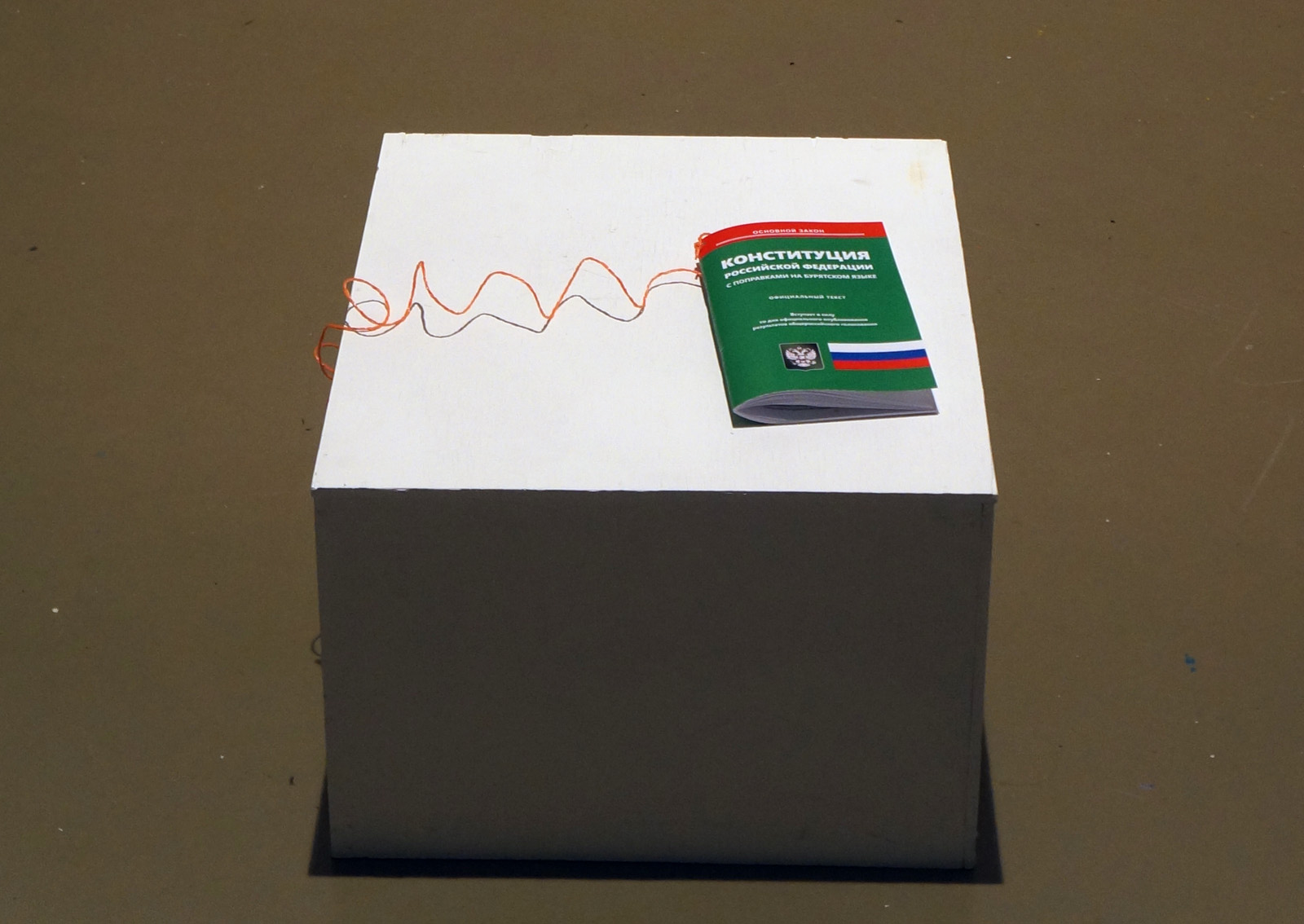
Finally, in the next section, the printed Constitution is presented, featuring the same design currently distributed nationwide. All amendments have been inserted in the Buryat language. This raises the question of the origin of the Buryat language. It is derived from Monastyrsky’s works, as he selected this language. Notably, during t this project, it became evident that no official Russian Constitution exists in the Buryat language. Consequently, only the amendments were translated into Buryat. In this context, the Buryat language functions as a metaphor, specifically as a ‘zaum’ insertion.
‘Zaum’ refers to a movement associated with the Russian Futurists, including figures such as Alexei Kruchenykh, who authored the well-known poem ‘Dyr bul shyl ubesh shur skum vy so bu r lez’. He asserted that this poem embodied more of the authentic Russian spirit than all of Pushkin’s poetry, which generated significant controversy. Possibly as a result of this controversy, the poem was included in our school curriculum, despite the general prohibition of Futurism in Soviet schools, with the exception of Mayakovsky. Ultimately, this poem has become an icon of the Zaum language. In this context, the use of the Buryat language serves as a metaphor for the Zaum language and for a state of total breakdown.
Finally, the entire installation is transformed into a book, shifting from a three-dimensional spatial entity into a printed textual object displayed on a podium. Titled The Constitution, this textual object allows the installation to be perceived as a kind of moonshine still—a device that converts the sound of a mosquito’s buzz into a new Constitution with amendments in the Buryat language. This metaphor is embedded directly within the work.
The concept of incorporating the mosquito sound through loudspeakers was carefully considered. For the exhibition, I significantly refined and clarified the presentation of this idea. The idea of translating the amendments into the Buryat language and integrating them into the Constitution occurred to me as soon as the amendments were introduced. I perceived these changes as a personal affront. While I do not claim to be an ardent supporter of the Yeltsin Constitution, the manner in which the protocol and the enacted amendments were handled represents, in my view, a profound violation of constitutional norms. The process exhibited a level of absurdity, audacity, and disregard for legal frameworks and basic logic that is difficult to overstate. Furthermore, one amendment, specifically the one concerning ancestral traditions, ispoorly constructed even by Russian-language standards.
In other words, the concepts of connecting the amendments, the Buryat language, and the sound of buzzing mosquitoes emerged when the amendments were first implemented. And that was the trigger. But the idea had been around for a long time."