Cadavre Exquis and Dodici Suicide
2014
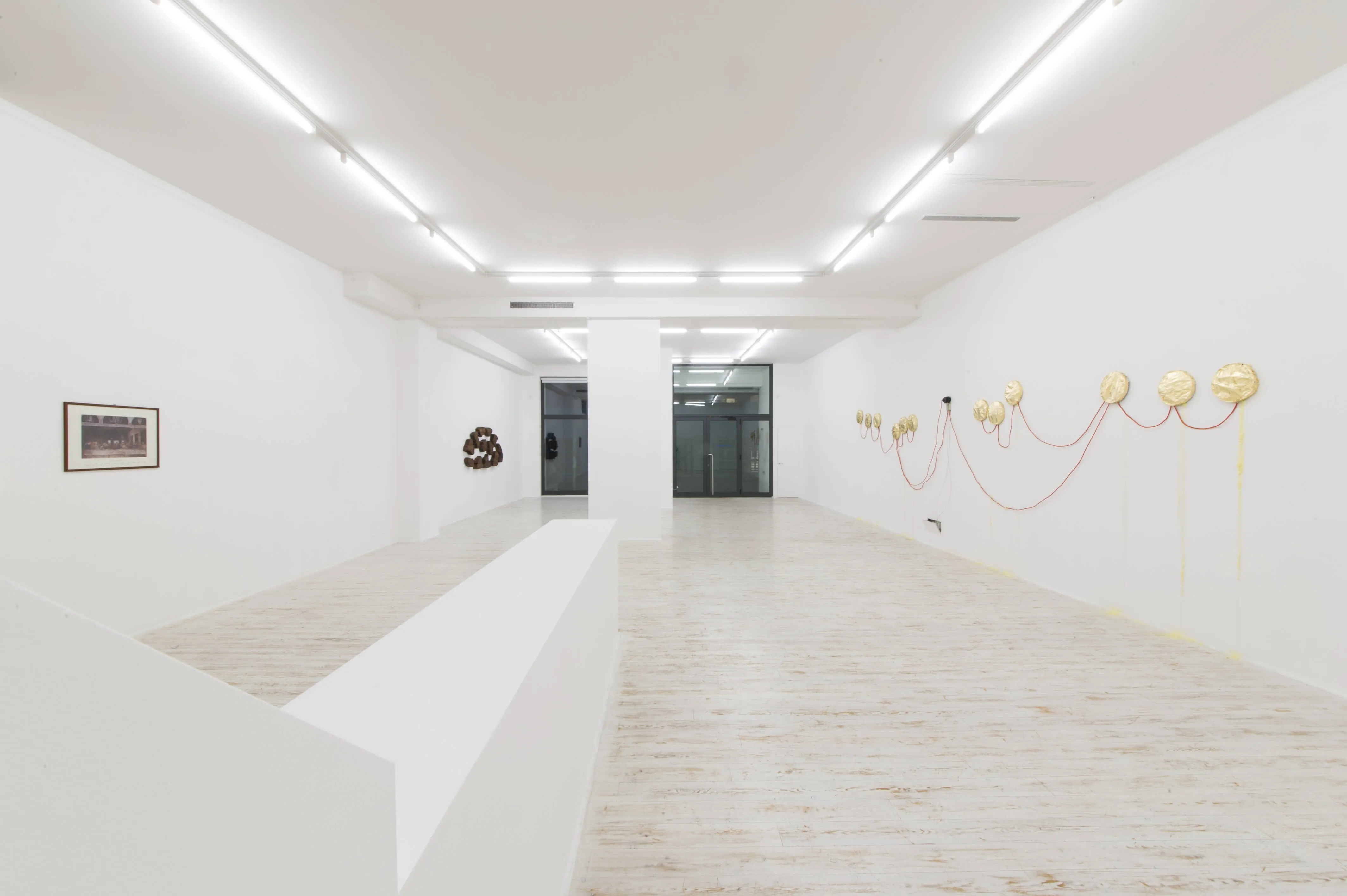
Exhibition at the Thomas Brambilla Gallery, Bergamo
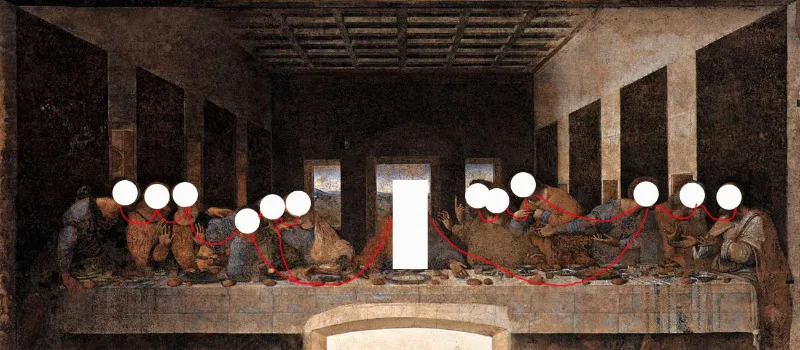
The exhibition's title refers to the central work of the solo show — a reinterpretation of The Last Supper by Leonardo da Vinci in 1:1 scale — and to a famous surrealist practice, Cadavre Exquis, a process of collective creation of a text or an image in which each participant writes or draws without knowing the contribution of others.
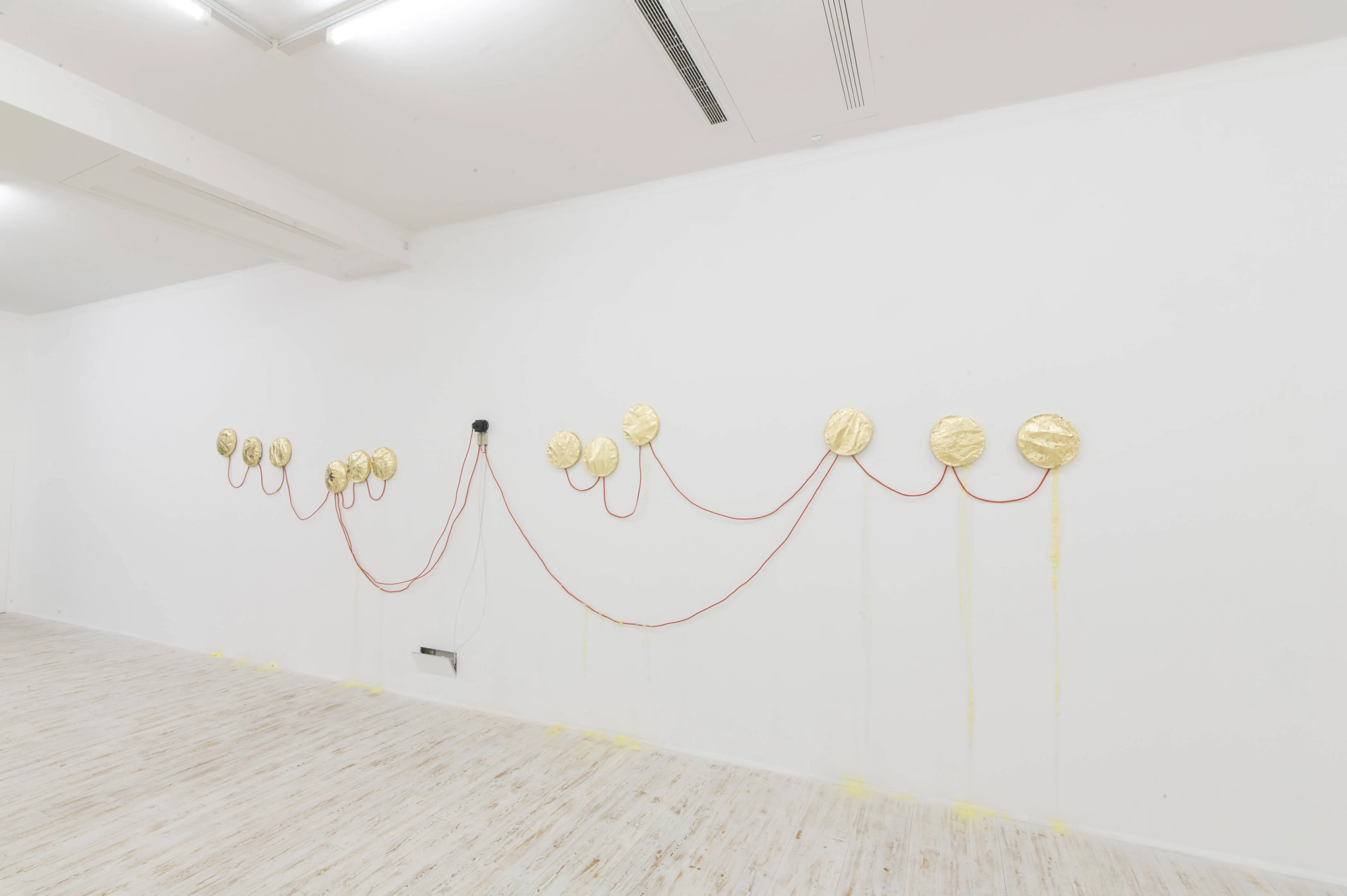
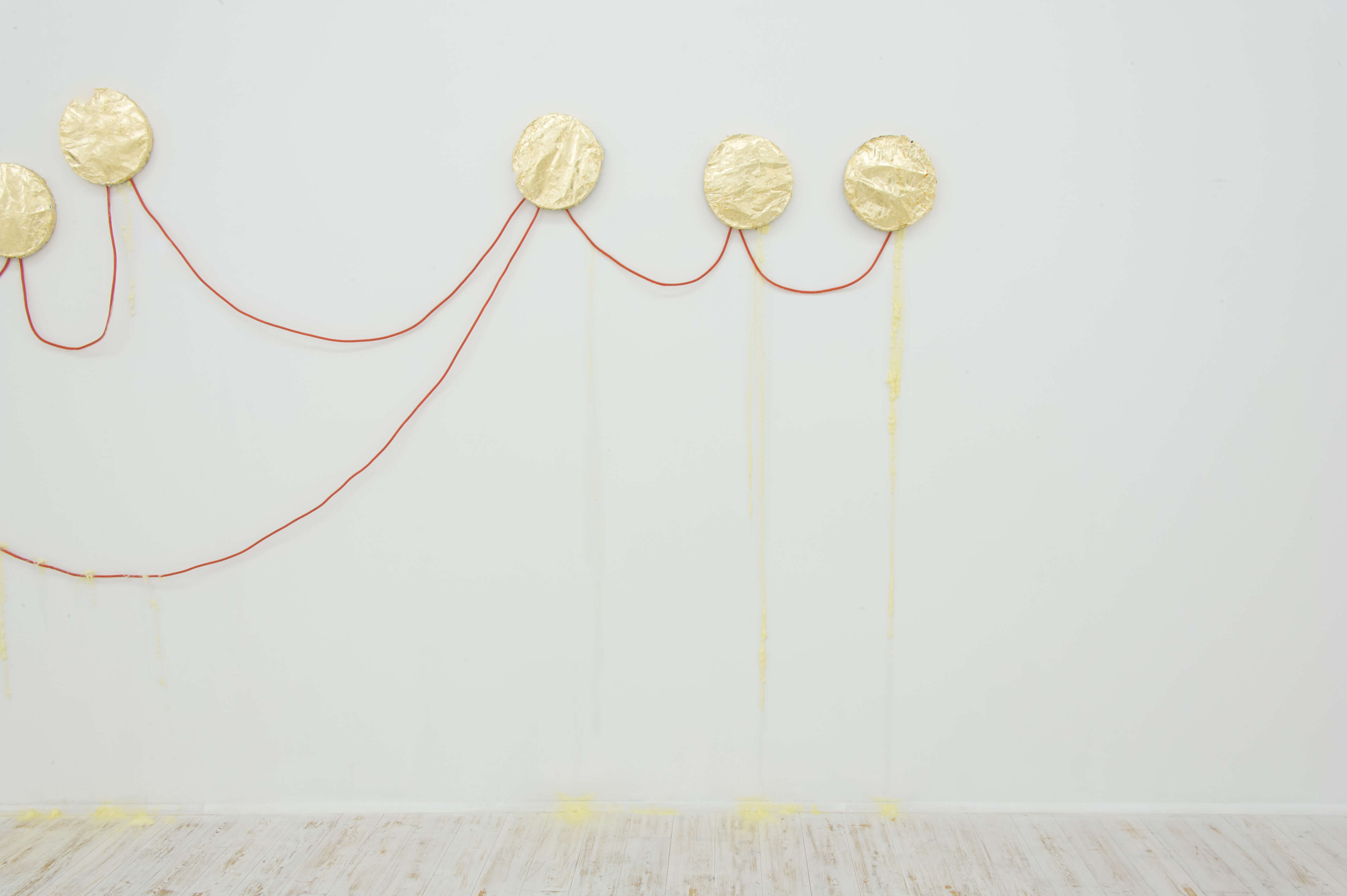
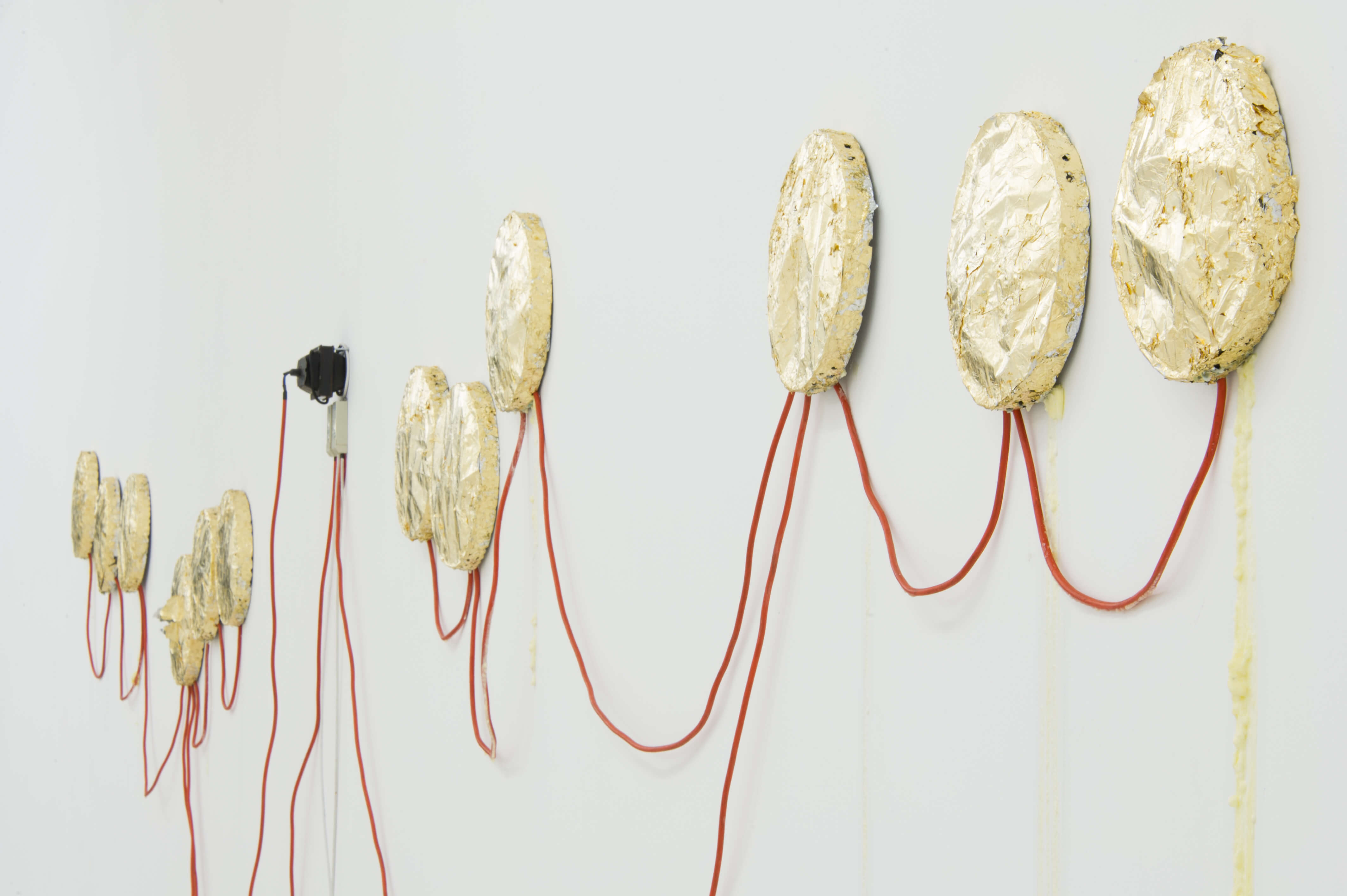
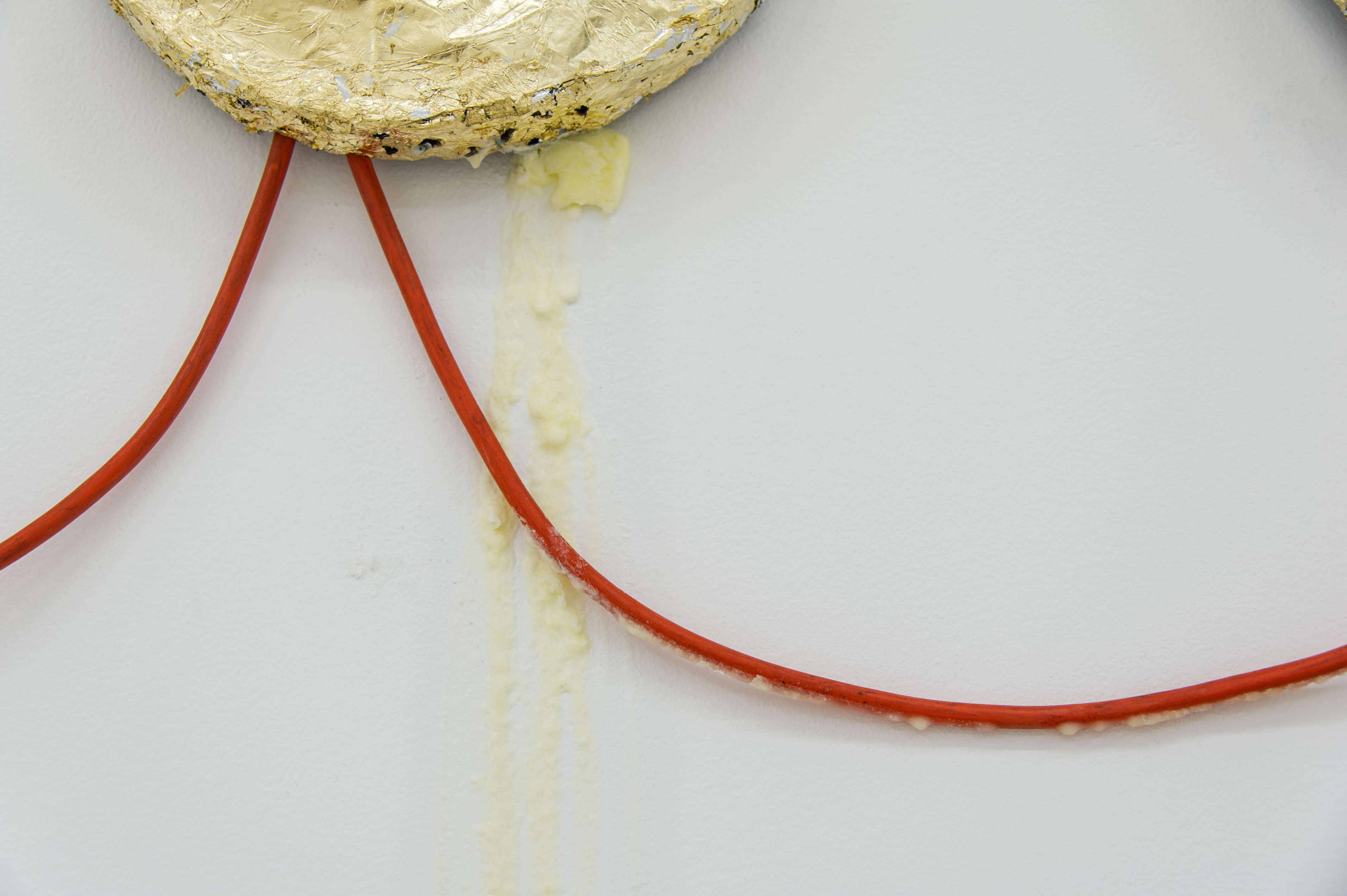
The installation is composed of twelve metal circles filled with butter, representing the apostles, and covered with gold leaf. Jesus is represented by an electrical transformer, from which unfolds a network of orange electric cables connecting all metallic circles. Jesus is the source of radiant energy.
Each metal circle is backlit by warm yellow light, which melts the butter, creating drips on the wall and floor, forming irregular stripes, heaps, and yellow spots. The apostles therefore contain two complementary aspects: the gold leaf and the circle evoke the immaterial and spiritual dimension, while the butter and drippings reference the corporeal, material, and earthly dimension.
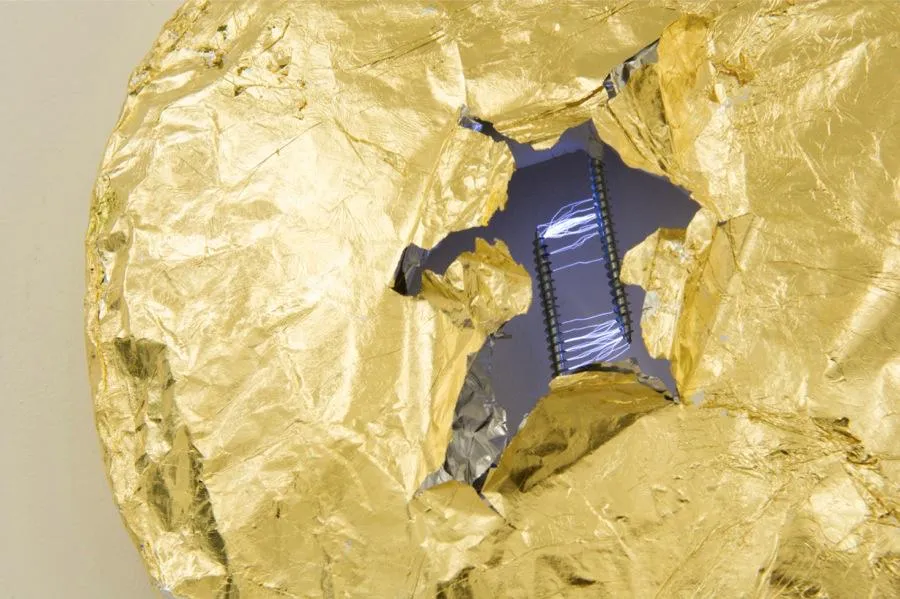
In the position corresponding to Judas, the gold leaf is broken by a gash, revealing a short circuit — a blue flash that emits a high-pitched and shocking sound. Judas marks the point and moment in which the energy undergoes a short circuit, deviating from its course.
The Twelve Apostles — Twelve Suicides gravitate around the central Cadavre Exquis in a game of ambiguity between life and death. The elimination of Leonardo’s elegance and malice gives way to symbolism emphasizing the social and political dimension of the work, while never abandoning a formal appearance dear to Osmolovsky and typical of his poetry.
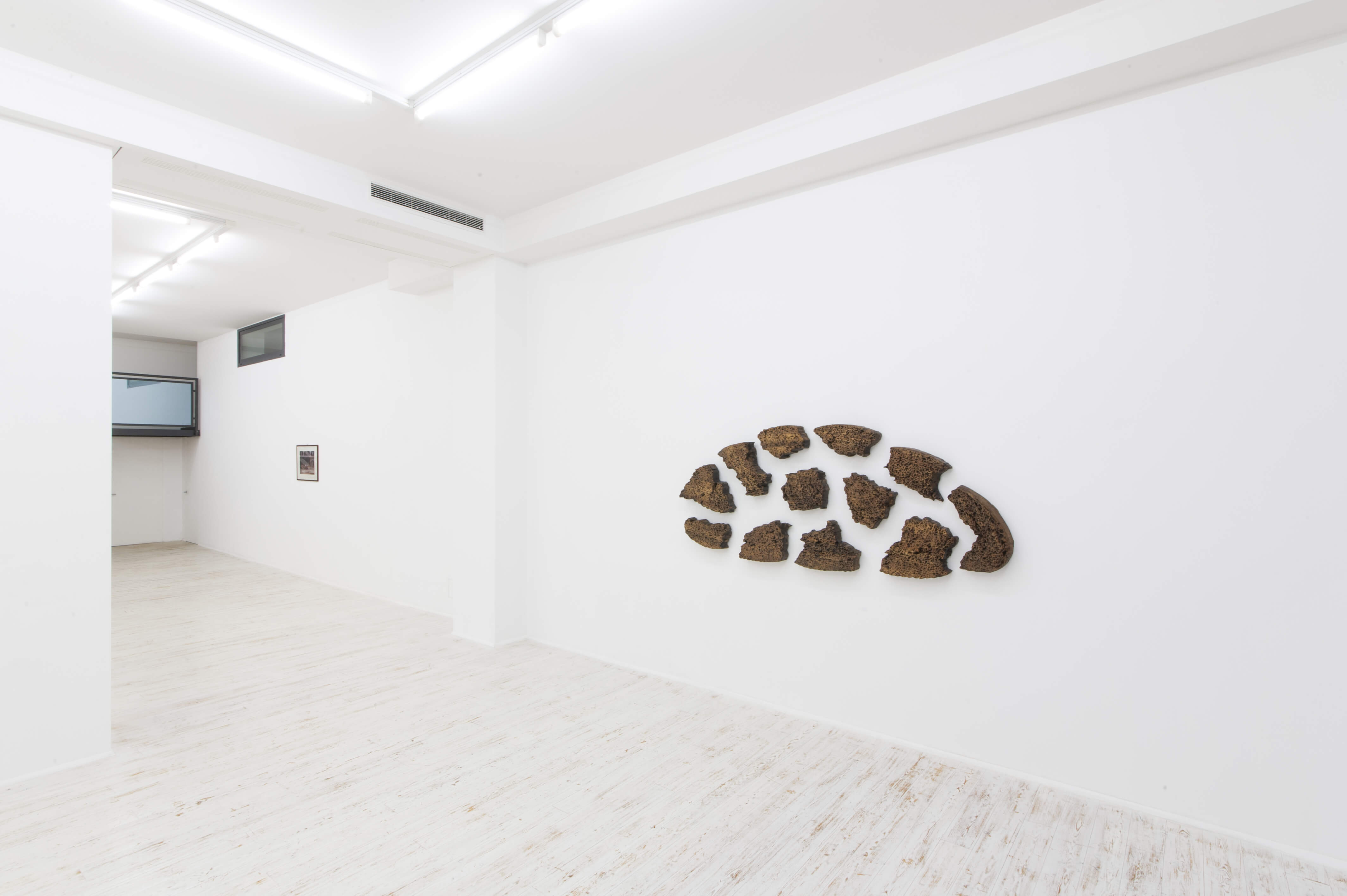
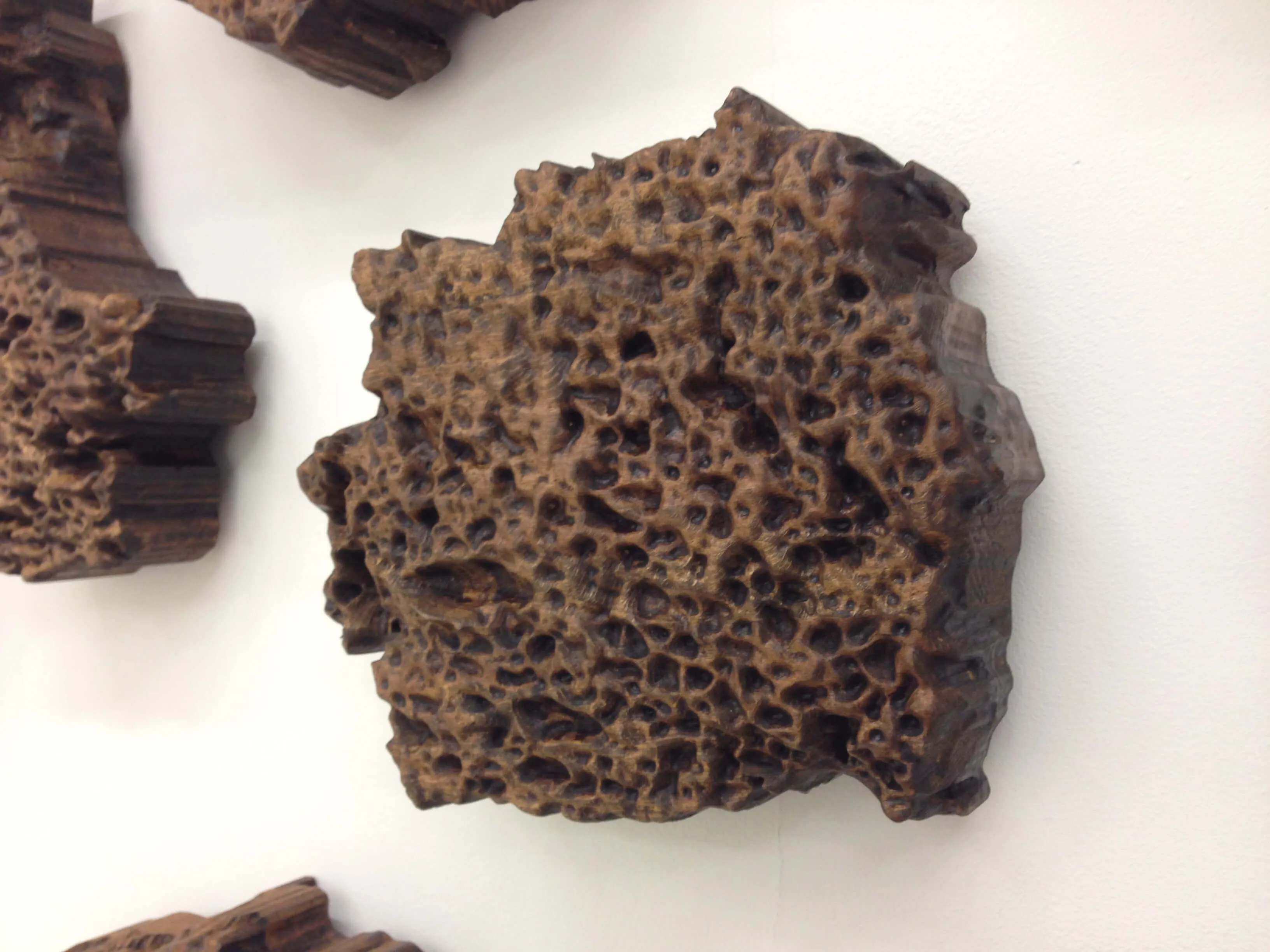
Continuing the message of the mural are the famous Bread Series, also featured in the show — icons made of wood or bronze with carved surfaces. The twelve pieces of sliced bread evoke the theme of the Twelve Apostles — Twelve Suicides (Dodici Suicidi) installation.
Interview with Anatoly Osmolovsky
Discussing "Exquisite Corpse and Twelve Suicides"
Q: How did you come up with the idea of "Exquisite Corpse and Twelve Suicides" commissioned by Thomas Brambilla's gallery?
A: The name of this work is a quote from Dmitry Pimenov's novel Муть, who, in my opinion, is the most radical and experimental poet in contemporary Russian literature. We have been friends for a long time, and I was astonished by this juxtaposition of surrealism and Christianity, the notion of Christ and the corpse. Since then I have wanted to transform this line into an image. Last year, when I saw The Last Supper by Leonardo da Vinci in Milan, I realized that I should use its composition as the basis for my work. That's why I placed the halos exactly where the heads of the apostles are in the fresco painting. The invitation to arrange a personal exhibition at Thomas Brambilla's gallery brought this project to life.
Q: How are the surrealistic Cadavre Exquis, as an artistic method, and The Last Supper by Leonardo da Vinci related in your installation?
A: If we recall what exactly Leonardo depicted in the fresco, the connection between the surrealist game and the episode of The Last Supper becomes clearer. Leonardo conveyed a precise moment of incomprehension and astonishment that appeared after the apostles had heard Christ's fateful words: "One of you will betray me."
Also, Cadavre Exquis is based on the principle of not knowing what your game partner wrote. So the drama of the fresco painting and the surrealist game are both built on purposefully organized unawareness.
Q: In comparison with other halos, the golden circle with a torn center illustrates Judas and creates a visual and audio disbalance. What meaning do you attach to this image?
A: I can say that this is the humorous element of the work. There is a Russian idiom "short circuit" that conveys the meaning of misapprehension and confusion. Such a short circuit can appear in an electrical flux as a spark — basically an error. It represents a metaphor for a person who constantly does everything in the wrong way, repeating the same mistake over and over again. The spark in a torn circle also creates a visual balance with the slowly melting butter on the wall.
Q: The melted butter in the halos of other apostles conveys the dramatic spirituality mentioned in the title. Why did you prefer the word "suicide" over "suffering" in a Christian-themed work?
A: Of course, slowly melting butter rather symbolizes suffering. Suicide is something that happens in a single act. I believe that the explicit atheistic meaning of the exhibition's title makes the work more complicated, paradoxical, and at some point scandalous. This is because the religious viewpoint does not allow perceiving Christ as a mortal man who would leave a rotten corpse after his death.